Pearson Edexcel · GCSE · Business
Course version: 1BS0 · Version from Sept 2017
Impacts of technology on production: ● balancing cost, productivity,…
Full specification wording
Business operations: Impacts of technology on production: ● balancing cost, productivity, quality and flexibility.
Introducing technology into production, such as robotics or computer-aided manufacturing (CAM), transforms business operations but requires careful balancing.
Checked against the Pearson Edexcel 1BS0 specification (opens in a new tab) on .
- Point 3 of 3
Study notes
From the checked teaching notes for this specification point.
The idea
Introducing technology into production, such as robotics or computer-aided manufacturing (CAM), transforms business operations but requires careful balancing. Initially, technology incurs high capital costs for purchase and installation, but it significantly boosts long-term productivity by operating continuously without fatigue. Technology also enhances quality by reducing human error, ensuring consistent, defect-free products. However, highly automated systems can sometimes reduce flexibility, as reprogramming machinery for custom orders can be complex and expensive compared to skilled human workers. Businesses must weigh these high initial costs and potential losses in flexibility against the long-term gains in productivity and consistent product quality.
What earns the marks
- Identify specific technologies used in production, such as automation, robotics, or 3D printing.
- Explain how technology increases productivity by speeding up production rates and reducing downtime.
- Analyse the impact of technology on quality, specifically through precision, consistency, and the reduction of human error.
- Evaluate the trade-off between the high initial capital costs of technology and the long-term savings in labour costs.
- Discuss how technology affects flexibility, noting that while some programmable machinery increases adaptability, rigid assembly lines can reduce it.
Common mistakes and how to put them right
Stating that technology always reduces costs immediately.
Put it right: Technology usually increases short-term costs due to high initial investment, but lowers long-term average unit costs.
Assuming technology always improves flexibility.
Put it right: While computer-aided design (CAD) improves design flexibility, heavy automated machinery can make it harder to switch production lines quickly.
Claiming technology eliminates all quality issues.
Put it right: Technology reduces human error but can still produce defective batches if machines are incorrectly calibrated or maintained.
Exam tips
- Use the concept of 'trade-offs' when evaluating technology, explicitly weighing the benefits of productivity against the drawbacks of high initial costs.
- Link the impact of technology to the specific business size; a small business may struggle with the capital cost of automation compared to a multinational.
- When discussing quality, mention 'consistency' and 'reduced wastage' as key benefits of automated production.
Try the lesson
The start of the Business operations: Impacts of technology on production: ● balancing cost, productivity, quality and flexibility. lesson, made from checked teaching notes for this specification point.
Have a go first
A car manufacturer installs robotic arms to weld car frames. What is the most likely impact of this technology on the quality and productivity of the manufacturing process?
Listen
Introducing technology into production, such as robotics or computer-aided manufacturing (CAM), transforms business operations but requires careful balancing. Initially, technology incurs high capital costs for purchase and installation, but it significantly boosts long-term productivity by operating continuously without fatigue. Technology also enhances quality by reducing human error, ensuring consistent, defect-free products. However, highly automated systems can sometimes reduce flexibility, as reprogramming machinery for custom orders can be complex and expensive compared to skilled human workers. Businesses must weigh these high initial costs and potential losses in flexibility against the long-term gains in productivity and consistent product quality. A strong answer earns marks for these points. Identify specific technologies used in production, such as automation, robotics, or 3D printing. Explain how technology increases productivity by speeding up production rates and reducing downtime. Analyse the impact of technology on quality, specifically through precision, consistency, and the reduction of human error. Evaluate the trade-off between the high initial capital costs of technology and the long-term savings in labour costs. A common slip: Stating that technology always reduces costs immediately. Instead, technology usually increases short-term costs due to high initial investment, but lowers long-term average unit costs. Exam tip: Use the concept of 'trade-offs' when evaluating technology, explicitly weighing the benefits of productivity against the drawbacks of high initial costs.
See it
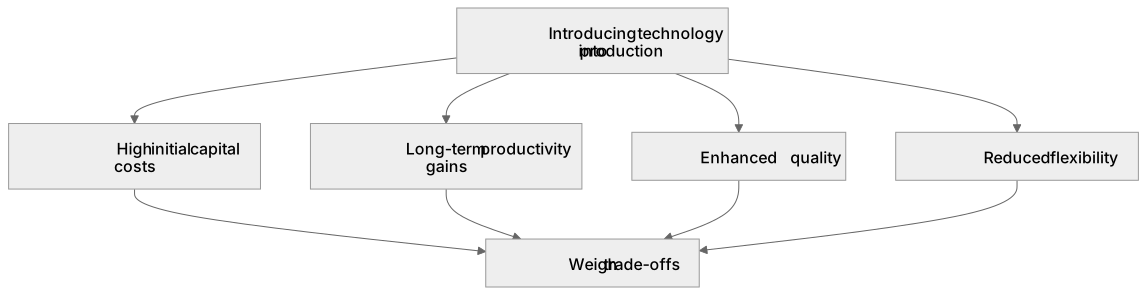
Label the diagram
Some boxes have lost their names. Pick the right name for each number.
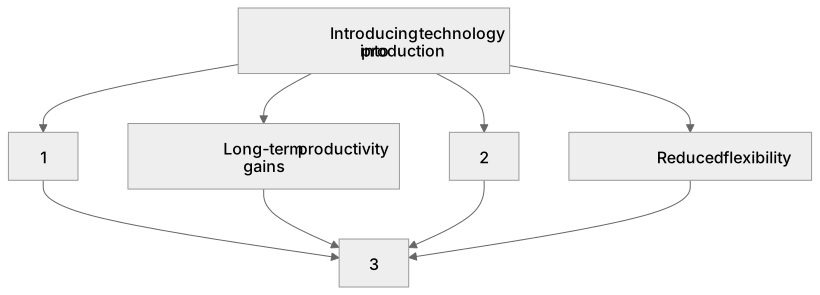
1Box 1
2Box 2
3Box 3
There is more to this lesson
The full lesson goes on to check your understanding and help you earn the marks. Create a free account to carry on, with your progress saved.
A week of Premium from your first lesson · Then the free plan continues · No card, no charge
Test your understanding of Business operations: Impacts of technology on production: ● balancing cost, productivity, quality and flexibility.
Active recall beats re-reading. Take an instant quiz now to test what you’ve learned and lock it into long-term memory.
A week of Premium from your first lesson · Then the free plan continues · No card, no charge